The Swiss hiring market turned in your favour — most employers have not noticed
Two Swiss datasets published within months of each other point in opposite directions, and the contradiction is the whole story.
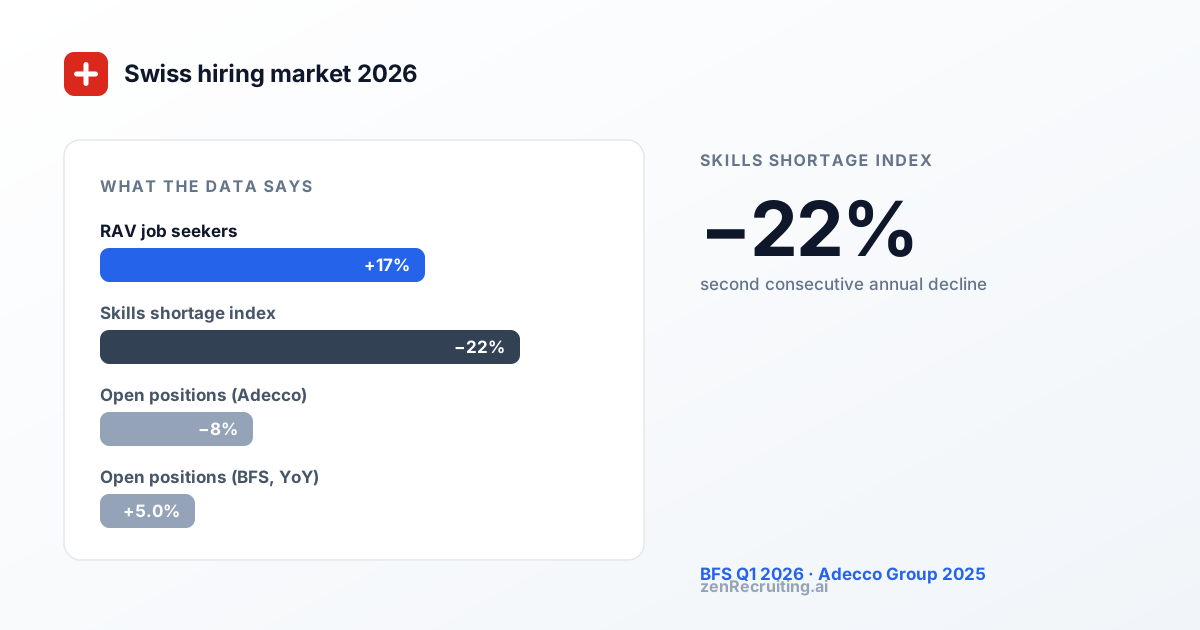
The Federal Statistical Office counted 5.0% more open positions in Q1 2026 than a year earlier. The Adecco Group’s Swiss Skills Shortage Index, meanwhile, fell roughly 22% — its second consecutive annual decline — with RAV-registered job seekers up 17%.
More vacancies, but far less competition for each candidate. If you run hiring at a small Swiss company, that combination changes what a good process looks like, and almost nobody has adjusted.
Short version
- Is it easier or harder to hire in Switzerland in 2026?
- Easier, on balance. Open positions rose 5.0% year over year in Q1 2026 (BFS), but the skills shortage index fell about 22% and RAV-registered job seekers rose 17% (Adecco, 2025). More roles are open, yet each one draws a larger and less contested applicant pool.
- Which Swiss roles are still hard to fill?
- Only 4 of 32 occupational groups still show a clear supply–demand imbalance. Healthcare specialists remain first, driven by an ageing population. Office, administrative, commercial and ICT roles saw the sharpest easing.
- Does this differ by region?
- Yes, substantially. The skills shortage fell 23% in German-speaking Switzerland versus 17% in Latin Switzerland, and Zurich saw the steepest drop at 29%. A Zurich office role and a Ticino healthcare role are not the same hiring problem.
- What should a small employer change?
- Shift effort from sourcing to filtering. In a tight market the bottleneck is finding anyone; in this market it is reading a much larger pile fast enough that good candidates do not go elsewhere while you decide.
What actually changed in the Swiss labour market?
Vacancies grew while candidate scarcity eased — an unusual combination that hands employers leverage they have not had since before 2022.
The BFS employment barometer for Q1 2026 put the job vacancy rate at 1.7% overall: 1.9% in the secondary sector, 1.7% in the tertiary. Companies reported 5.0% more open positions than a year earlier, split between +6.8% in the secondary sector and +4.5% in the tertiary. Employment reached 5.537 million, up 0.5% year over year.
Read alone, that looks like a tightening market. The Adecco index tells the other half: skills shortage down roughly 22%, open positions in their measure down 8%, RAV-registered job seekers up 17%, and unemployment up from 2.3% to 2.8%.
The two are not in conflict — they measure different things over different windows. Together they describe a market where demand is recovering while supply has recovered faster. That is the definition of employer leverage.
The practical consequence: your next job ad will very likely draw more applicants than the same ad drew two years ago, and a larger share of them will be genuinely employable.
Sources: BFS employment barometer Q1 2026; Adecco Group Swiss Skills Shortage Index 2025. Bars show magnitude of change, not direction.
Which roles are still genuinely hard to fill?
Four of 32 occupational groups still show a clear imbalance — healthcare above all — while the roles most small companies hire for have eased sharply.
The 2025 index found only 4 of 32 occupational groups with a clear mismatch between supply and demand. Health professions remain at the top, and demographics mean that is unlikely to reverse.
The sharpest easing hit office, administrative and commercial roles, and ICT and IT roles — both groups the report ties to AI exposure. If you are hiring an office manager, a commercial assistant or a mid-level developer, you are hiring into a materially looser market than in 2023.
This matters for how you budget attention. A healthcare hire still justifies active outreach and a premium. A commercial role probably does not — there, the risk is drowning in applications, not attracting them.
Why does the region matter so much?
The easing was 23% in German-speaking Switzerland versus 17% in Latin Switzerland, and 29% in Zurich alone — so national averages will mislead you.
Zurich saw the steepest decline at 29%. German-speaking Switzerland overall fell 23%; Latin Switzerland 17%. That spread is wide enough that a national figure is close to useless for planning a specific hire.
If you are hiring in Zurich for an office or ICT role, expect a deep pool. If you are hiring in Romandie or Ticino, expect less slack — and if it is a healthcare role there, expect the old market.
The operational point: set expectations per role and per canton, not per country. Reusing last year’s Zurich assumptions in Lausanne is how a search quietly runs three months over.
What should you actually change in your process?
Move your effort from finding candidates to filtering them, and compress the time between application and first human contact.
In a scarce market, the winning move is outreach: find the few people who exist and court them. In this market, for most roles, the winning move is throughput — read a bigger pile faster and get to the good ones before someone else does.
That means the expensive step is no longer sourcing. It is the days between an application landing and a human replying. A larger applicant pool makes slow processes more costly, not less: the strongest candidates in a loose market still have options, and they still leave first.
Three concrete changes worth making. First, screen on evidence rather than CV formatting — a bigger pool means more strong candidates with unconventional CVs. Second, cut your time-to-first-reply to under 48 hours, even if the reply is a rejection. Third, keep a shortlist warm rather than closing the search the moment you sign someone; in a market this volatile, your second choice is worth staying in touch with.
None of this requires an HR department. It requires that reading applications stops being the thing that waits until Friday afternoon.
Does this mean you should stop sourcing passively?
No — but the case for it is now role-specific rather than universal.
Passive sourcing earns its cost where the pool is genuinely thin: healthcare, senior specialists, and roles in Latin Switzerland where the easing was smallest.
For a commercial or junior ICT role in Zurich in 2026, spending heavily on outreach while applications pile up unread is solving the wrong problem.
The honest test is simple: count how many qualified applicants your last job ad produced, and how many you actually replied to within a week. If the second number is much smaller than the first, you do not have a sourcing problem.
Tools that help with the filtering problem
If the bottleneck has moved from finding candidates to reading them, these are worth a look. The first is ours — flagged as such.
- zenRecruiting.aiour tool
Free applicant tracking with AI candidate sorting: every application scored and ranked against your job description, so a bigger pile does not mean a slower reply. Unlimited job postings on the free plan.
For the roles where the pool really is thin: 10 recommended Swiss candidates per week, including passive ones your job ad never reaches. First week free.
The official quarterly vacancy figures, broken down by sector. Free, and the source most Swiss hiring commentary is quietly paraphrasing.
The market moved, and hiring processes have not. Most Swiss SMEs are still running a playbook built for 2022 scarcity — heavy on sourcing, light on turnaround — into a 2026 market that rewards the opposite.
You do not need to rebuild anything. Look at your last search, count the qualified applicants you never replied to, and fix that number first.
Sources
- BFS — Employment barometer / open positions, Q1 2026 — Vacancy rate 1.7%; +5.0% open positions YoY; employment 5.537m (+0.5%)
- Adecco Group — Swiss Skills Shortage Index 2025 — Index −22%; open positions −8%; RAV job seekers +17%; unemployment 2.3%→2.8%; 4 of 32 groups imbalanced; Zurich −29%