Hiring Without HR: What to Keep, Drop, and Automate in Your Swiss SME
You're running a tight team. Nobody has 'HR' on their business card. Yet last month you opened a position, and suddenly you're reading 40 applications, scheduling calls, comparing notes on scraps of paper. It works, sort of—but it's exhausting.
The Swiss job market is shifting. Vacancy rates sit at 1.7%, down from earlier peaks, and the Adecco Group's latest index shows the skills shortage cooling for the second year running. That actually works in your favour as a smaller employer: less competition for talent means you can be smarter about process instead of faster.
Short version
- Do I really need all those hiring steps?
- No. Most SMEs can skip phone screenings and reduce rounds to two: a structured conversation, then a practical check-in. What matters: clear job description, consistent evaluation, and someone taking notes.
- What should I automate first?
- Application sorting and interview scheduling. A tool that filters by key qualifications and sends calendar links saves you hours every cycle. Everything else—the actual conversation, the decision—stays human.
- How long should hiring take?
- For a standard role in Switzerland, aim for three to four weeks from posting to offer. Longer than that and candidates accept other jobs; shorter and you skip due diligence.
- What if we get very few applications?
- Check your job posting: is the role description honest about salary, location, and what you actually need? A short, direct posting often beats a long one. Consider where your talent hangs out—not always LinkedIn.
Which hiring steps are non-negotiable for a small team?
You can't skip the fundamentals, even if you're stretched thin.
Start with a written job description. Not a novel—three or four sentences. What does the role do? What does success look like in month three? What's the salary band? Vague postings attract vague candidates and waste everybody's time.
Second: a structured first conversation. Call three or four shortlisted candidates. Ask each person the same questions, in the same order. Takes 30 minutes per person. Jot down their answers. This alone cuts bias and gives you something to compare.
Third: a practical trial or real-world task. If it's a designer, ask them to sketch something. If it's a salesperson, do a mock pitch. If it's operations, walk through a scenario. A two-hour task beats years of interview guessing.
Finally: reference calls. Not a formality. Ask former managers: Did this person show up? Could they solve problems? Would you hire them again? One honest reference often tells you more than a polished interview.
What can you safely drop?
Some steps feel professional but don't actually predict who'll succeed.
Personality tests and culture-fit assessments: They're often pseudoscience, they slow you down, and in Switzerland they can trigger privacy questions. Skip them unless you have legal advice otherwise.
Phone screening before the first real call: If you have 20 applications, a quick read of CVs and a one-shot structured conversation is faster than two rounds of chats. Lose one layer.
Formal presentations to a panel: For most SME roles, an interview with one decision-maker and maybe a peer is enough. A big meeting adds theatre and exhaustion, not clarity.
Endless follow-up interviews: Two rounds is the Swiss standard. A third round should be rare and short (just a handshake and final questions). If you still can't decide after two rounds, the candidate probably isn't the fit.
Where does automation actually save you time?
Machines are good at sorting and scheduling; humans are good at deciding.
Application filtering: A tool that reads CVs and covers, and flags candidates who match your core criteria (education, years of experience, location), saves you hours. You still read the shortlist, but it's 5 people, not 40.
Calendar scheduling: A link that lets candidates book a time slot, and auto-sends reminders, eliminates back-and-forth email. Pure time win.
Structured interview notes: A template you fill in during the call—candidate name, key answers, yes/maybe/no—keeps your evaluation consistent and clear. Low-tech automation.
Background and reference coordination: A simple form that collects contact details from the finalist and auto-sends reference requests can be done by email or a lightweight tool. One person manages it; everyone else stays focused on the candidate experience.
What not to automate: the actual hiring decision, feedback to candidates, and anything that touches your company culture or values. That's where a founder or hiring manager must be present.
What does the Swiss labour market tell us right now?
The 2025 data suggests SMEs have more room to be selective and deliberate.
The Swiss skills shortage index fell 22% year on year—the second consecutive drop. Job vacancies are down 8%, and unemployment ticked from 2.3% to 2.8%. For most SMEs, this is good news: less panic hiring, more time to find the right fit.
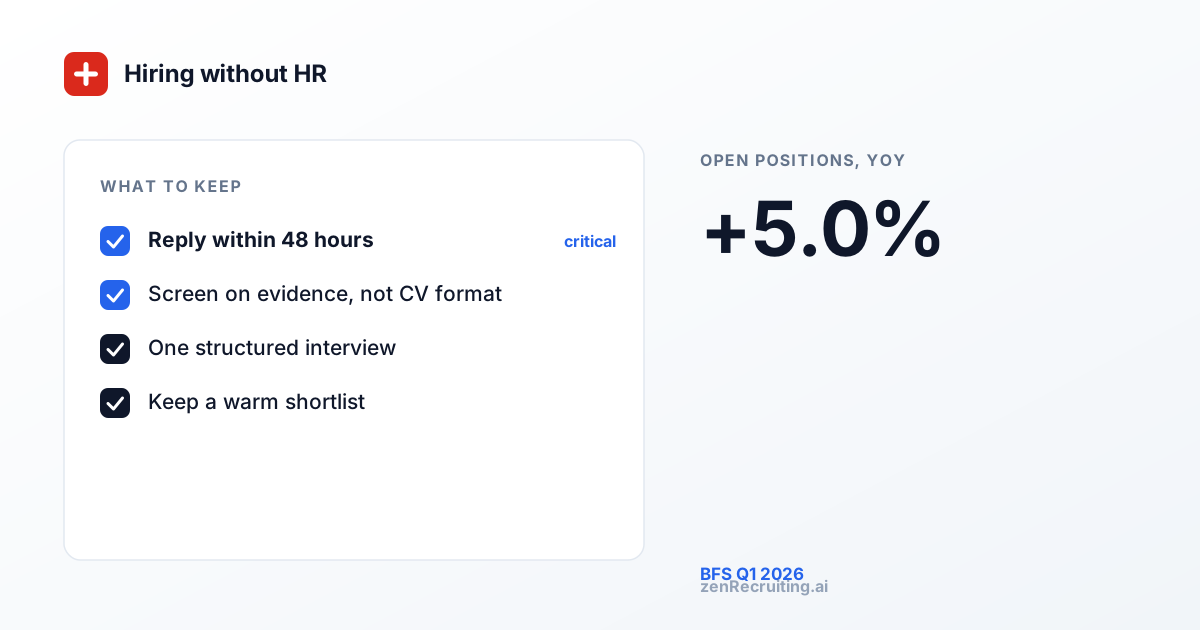
Open positions are still growing overall (up 5.0% year on year), but growth is slower than it was. In German-speaking Switzerland, the index fell 23%; in Latin Switzerland, 17%. Zurich saw a 29% drop. If you're in a region or sector with fewer openings, your process needs to be strong so you don't lose candidates to delay.
Only four of 32 occupational groups show clear imbalance; health professions are the outlier. For most other roles, you're competing with other employers on culture, clarity, and speed—not just cash. A crisp, fair hiring process actually sets you apart.
The takeaway: you don't need to move at panic speed, but you do need to move with intention. Three to four weeks is realistic. Vague, slow, or clumsy hiring will lose candidates to firms that are clearer.
Source: Adecco Group Swiss Skills Shortage Index 2025
What tools actually help?
You don't need expensive HR software. A few focused tools—or even well-organised spreadsheets—can handle most of the work.
- zenRecruiting.aiour tool
Application filtering, interview scheduling, and candidate tracking in one place. Designed for teams without HR staff.
Free tier handles scheduling and reminders. Integrates with most email and calendar systems.
Collect structured interview notes, reference requests, or feedback from team members on candidates.
Hiring without an HR person is not a weakness if you're methodical. Start with clarity: a tight job description, a structured conversation, a practical test. Automate the paperwork and scheduling. Keep the decision human. At 1.7% vacancy rate, the pressure is off to hire fast; use that space to hire well. And if you're looking to tighten your process and save hours, that's exactly what tools like zenRecruiting.ai are built for.
Sources
- BFS Employment Barometer Q1 2026 — Job vacancy rate 1.7%, open positions +5.0% year on year
- Adecco Group Swiss Skills Shortage Index 2025 — Skills shortage index -22% year on year, unemployment 2.8%