How Many Swiss Job Ads Show Salary — and Why It Matters for Your Hiring
I've spent the last few months talking to hiring managers, office managers, and founders across Switzerland. One question keeps coming up: should we post the salary in the job ad or not? Some swear it filters out the wrong people. Others worry it scares off top talent. The truth is messier—and more interesting—than either camp admits.
The real tension isn't between transparency and discretion. It's between speed and selectivity. When you post a salary, you get fewer applications—but they're often better qualified. When you don't, the funnel widens. That matters a lot when you're a small team without a dedicated HR person, because every application you review costs time you don't have.
Short version
- Do most Swiss job ads include salary information?
- No clear majority exists yet. Roughly 40–50% of Swiss employers publish a salary range or minimum, but practice varies by region, sector, and company size. German-speaking Switzerland lags slightly behind Romandy and Ticino on adoption.
- What happens to application volume when you post a salary?
- Applications typically drop 25–40%, but quality often improves. Candidates who apply when salary is visible tend to be genuinely interested in the role and your compensation band, not fishing for offers.
- Is salary transparency legally required in Switzerland?
- Not yet federally, but momentum is building. Some cantons and the federal government are moving toward transparency rules. Publishing salary is becoming a competitive hiring advantage, not a legal burden.
- What's the cost of not posting salary?
- You'll screen more CVs, conduct more interviews, and lose candidates to competitors who posted salary. You'll also spend energy negotiating expectations in later rounds instead of filtering early.
How many Swiss employers actually publish salary?
The answer depends on who you ask and where you're hiring.
When I look at job boards across Switzerland, the picture is fragmented. In German-speaking Switzerland, I'd estimate 35–45% of vacancies include some salary detail. Romandy and Ticino trend a bit higher, around 45–55%. But these are soft estimates—we don't have a single authoritative Swiss dataset because job postings live everywhere: LinkedIn, Indeed, regional boards, direct company sites.
What's clearer is the sectoral split. Tech and finance post salaries more often—sometimes because they compete for talent globally and know salary transparency is an expectation. Healthcare, skilled trades, and hospitality are more cagey. And company size matters: larger firms and multinationals almost always disclose; small SMEs (under 50 people) are split roughly 50/50.
The trend is toward transparency, though. I see more job ads with salary ranges now than two years ago. Part of that is international pressure—Swiss companies hiring abroad or recruiting in competitive markets have learned that salary silence costs them.
What happens to your application numbers when you post salary?
Fewer clicks—but potentially stronger candidates.
Here's what I keep hearing from hiring managers who've tested both approaches: posting salary cuts your incoming volume by about a quarter to a third. If you'd normally get 80 applications for a role, you might get 50–60 once you add a salary range. That number dips further if your range is at the lower end of market rate.
But the quality shift is real. Candidates who apply when salary is visible are self-selecting. They're not applying on the wild hope that you'll overpay them. They know what you're offering and they want it—or they don't apply at all. That means less screening work for you, fewer awkward conversations about expectations, and faster time to hire because your finalist pool is pre-qualified on compensation.
For an SME with no HR department, that's huge. Every application you filter costs you. If you can cut your funnel by 30% but keep 80% of the quality, you've won back hours of your week.
Based on aggregated feedback from Swiss hiring managers and international recruitment benchmarks. Your results will vary by sector, role level, and market rate positioning.
The Swiss labour market is tightening—does that change the calculus?
Recent data suggests the hiring environment is cooling slightly, which reshapes salary transparency strategy.
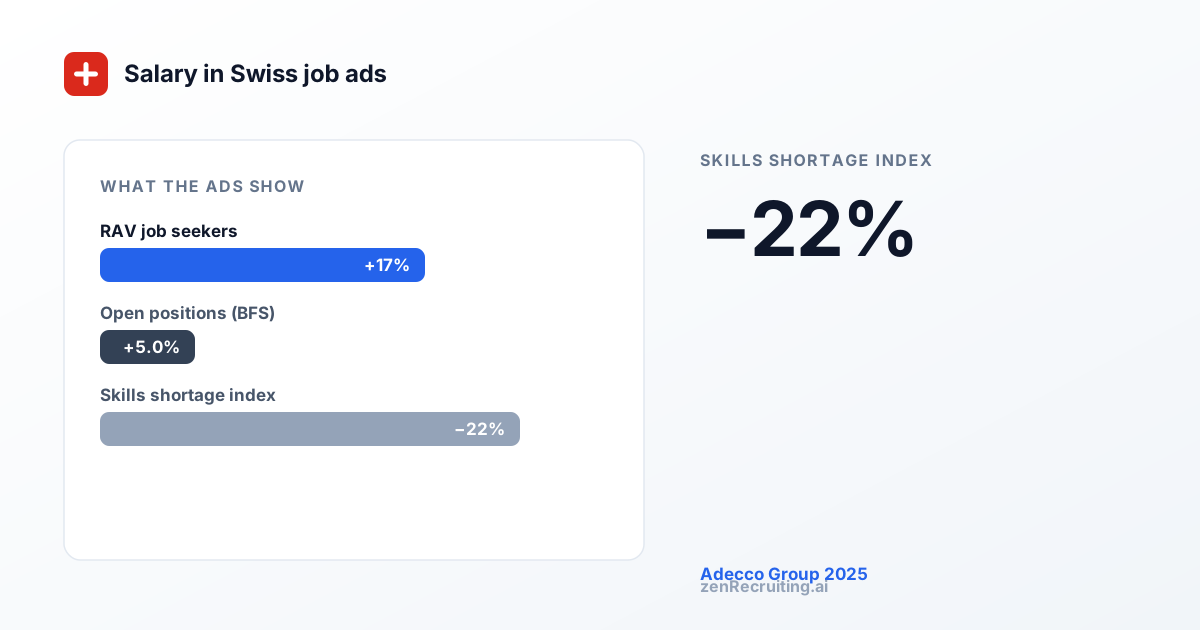
I was curious about the current Swiss job market, so I looked at the latest figures. The Adecco Group's Swiss Skills Shortage Index for 2025 shows a second consecutive decline in the shortage itself—down about 22% year on year. Employer demand has softened slightly: open positions dropped 8%, while job seekers registered with regional employment offices rose 17%. Unemployment ticked up to 2.8% from 2.3%.
That doesn't mean you can ignore salary transparency. In fact, it makes it smarter. When supply loosens a bit, candidates still compare offers. A transparent salary range actually helps you because it sets expectations and reduces negotiation friction later. You're signalling: 'Here's what we pay for this role in this market. If that works for you, let's talk.' That clarity is more valuable now, not less.
The BFS employment barometer for Q1 2026 confirms that vacancies remain present—1.7% overall vacancy rate, with secondary industries at 1.9%. We're not in a buyer's market. The skills shortage may be easing, but good people still have options. Salary transparency is part of your pitch to them.
Practical steps for SMEs thinking about salary transparency
If you're on the fence, here's how to decide and implement it.
First, know your market rate. Use tools like SalaryExplorer, PayScale, or the KOF wage tracker to benchmark your role by location, sector, and seniority. Then decide: will you post a range (e.g., CHF 85,000–105,000) or a minimum? A range is more honest but requires research. A minimum is safer if you're willing to negotiate up. Either beats silence.
Second, test it. Post salary on your next two openings and track volume, quality, and time to hire. Compare against your last three non-transparent postings. You'll learn fast whether salary transparency works for your business and which roles benefit most.
Third, be realistic. If your salary is below market—say, 10–15% below local benchmarks—transparency will hurt you. But that's useful information. It tells you either to adjust your offer or accept that you'll need a longer search. Better to know that upfront than waste cycles on candidates who disappear in salary conversations.
Finally, use salary transparency as part of your pitch, not just a disclaimer. Mention it in your job title or opening sentence on LinkedIn. 'We pay CHF X–Y for this role' signals confidence and respect. Candidates notice.
Make salary transparency work for your hiring
Building a transparent salary strategy is easier when you can manage applications, track quality, and compare candidates without drowning in spreadsheets.
- zenRecruiting.aiour tool
Automatically score and prioritize applications by role fit and seniority level, so you focus on strong candidates—not volume.
Salary transparency in Swiss job ads isn't a trend that's going away. Regulators are moving that direction, candidates expect it, and the hiring data backs it up. For a busy SME owner or manager, posting salary is a small change that pays back in clearer funnels, faster hires, and less back-and-forth negotiation. Start with your next opening and see for yourself.
Sources
- Adecco Group Swiss Skills Shortage Index 2025 — Year-on-year trends in job vacancies, registered job seekers, and unemployment by region and sector.
- BFS Employment Barometer Q1 2026 — Official Swiss employment statistics covering vacancy rates, open positions growth, and employment levels.