Passive Sourcing in Switzerland: When It Pays Off (and When You're Just Throwing Money Away)
You've probably heard the pitch: 'The best candidates aren't looking for jobs.' And you know what? There's truth in it. But here's what nobody tells you—the best candidates for *your* role might actually be actively looking right now, waiting on job boards or in your own network.
I've watched enough hiring cycles in Switzerland to know that passive sourcing can be brilliant. It can also be a very expensive way to feel like you're doing something. Let me break down when it makes sense and when you should spend that budget differently.
Short version
- Should we do passive sourcing if we have one open position?
- Probably not. Passive sourcing pays off when you're filling multiple roles, building bench strength, or hunting for genuinely rare profiles. One role? Post it actively and use your network first.
- What's the actual Swiss job market right now?
- The Skills Shortage Index fell 22% year-on-year. Vacancy rates are at 1.7%. Translation: candidates have more choices, but far fewer roles are genuinely 'hard to fill' than two years ago.
- Is passive sourcing more effective than posting actively?
- It depends entirely on your sector and seniority level. Health professions? Yes, do passive work. Mid-level admin roles? You'll waste money. Active recruiting plus referral incentives usually wins.
- How much budget should we allocate to passive sourcing?
- If you're an SME with one HR person, start with 20–30% of your recruitment budget, only if you're filling multiple roles. Otherwise, invest in job board optimisation and referral systems first.
What does the Swiss labour market actually look like right now?
The narrative around 'talent shortage' in Switzerland needs serious updating.
The Adecco Group Swiss Skills Shortage Index tells a story that contradicts the panic you might hear at networking events. In 2025, that index dropped 22% year-on-year—the second consecutive decline. Open positions fell 8%, while registered job seekers increased by 17%. Unemployment crept up from 2.3% to 2.8%.
This matters for your hiring strategy more than you'd think. The overall job vacancy rate sits at 1.7% (BFS Q1 2026), with slight variations by sector—secondary industries at 1.9%, tertiary at 1.7%. Yes, there are still openings. But they're more concentrated than the 'everyone's hiring' narrative suggests.
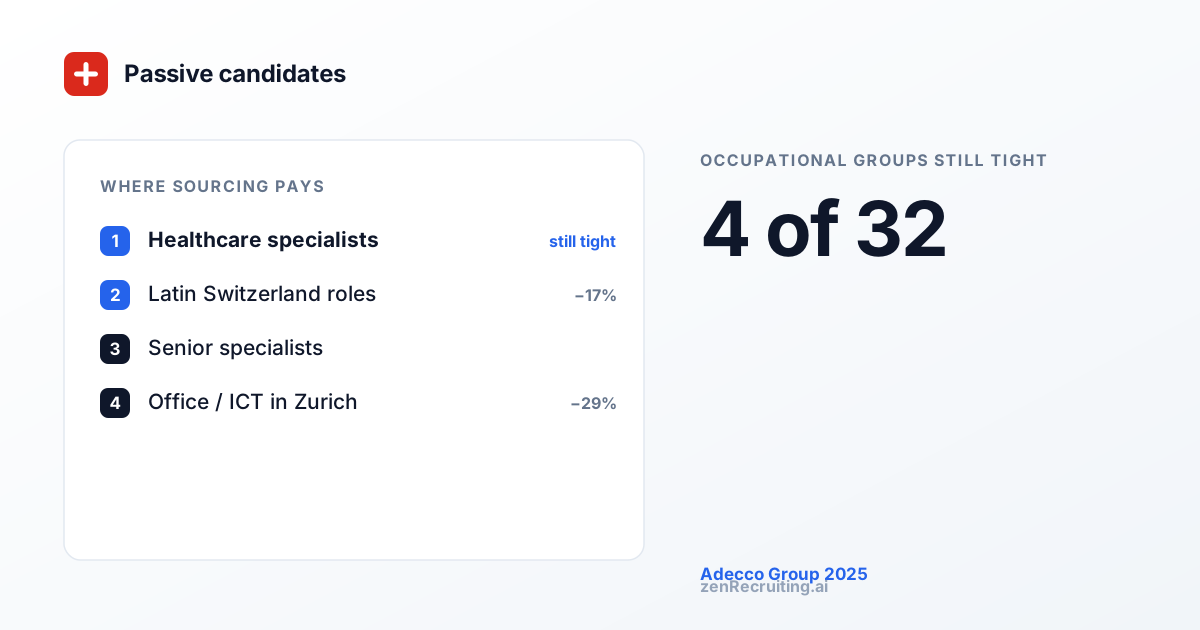
The kicker? Only 4 of 32 occupational groups show clear imbalance. Health professions lead the shortage list. Everything else has shifted from a seller's market back toward something more balanced. That changes when passive sourcing makes sense.
Source: Adecco Group Swiss Skills Shortage Index 2025
Which roles actually justify passive sourcing investment?
Not every job opening needs a hunting expedition.
Passive sourcing makes real sense in three scenarios. First: you're in a genuinely shortage-hit sector. Health professions are still screaming for talent. Specialised engineering roles in quantum tech or biotech. Senior leadership positions where you're not just filling a seat but reshaping culture. In these cases, waiting for active applications is leaving money on the table.
Second: you're building bench strength, not just filling today's gap. You know you'll need three developers next year, two senior designers in six months. Passive sourcing lets you start conversations now, build relationships, and move quickly when positions open. That's worth the investment.
Third: you're replacing someone senior, and the cost of a bad hire dwarfs the sourcing budget. A CFO hire, a key account manager, a technical architect. When the wrong person costs you €200k in disruption and replacement, spending €5k on passive sourcing is obvious maths.
Everything else? A solid job posting on the right boards, a small referral incentive, and a week of active recruiting will probably get you there faster. And cheaper.
Why passive sourcing often fails at SMEs (and what to do instead)
Passive sourcing requires resources most growing companies don't have.
Here's the friction: passive sourcing assumes you have someone doing it. Not as an afterthought, but as a job. You need someone who can research profiles, craft personalised outreach, follow up over weeks or months, and qualify people who aren't even looking. That's expensive when you're running lean.
At many SMEs, that responsibility lands on someone already drowning in job postings, interview scheduling, and onboarding. The result? Outreach gets generic. Follow-ups slip. Candidates never hear back or hear back six weeks later. You pay for passive sourcing and deliver active-sourcing-quality effort. Everyone loses.
My honest take: if you don't have dedicated sourcing bandwidth, spend your money on making your active job posts brilliant instead. A well-optimised posting on job4all, Indeed, or LinkedIn, with specific keywords and a clear company voice, will attract people still *actively* open to change. Add a referral bonus. Run a lunch-and-learn for your team: 'Know someone great? Send them our way, and we'll send you CHF 500.' That often delivers better candidates for less money.
Passive sourcing through a recruitment agency? That can work if you're filling multiple senior roles or if your niche is genuinely hard to reach. But make sure you're paying for actual sourcing, not just job posting under a different name.
The three-question checklist before you invest in passive sourcing
Use this to figure out if it's worth your budget.
Question one: Am I filling more than one role in the next six months? If yes, passive sourcing gets more efficient. If no, skip it. Question two: Is my role genuinely hard to find, or is it just hard to find *good* people? There's a difference. Hard to find = health professions, specialised engineering, niche regulatory expertise. Hard to find good people = you need better screening, not better sourcing. Question three: Do I have someone to actually do this sourcing work? Real sourcing, not 'posting jobs and hoping.'
If you're hitting 'no' on two or more, don't buy passive sourcing. Instead, optimise your active approach. Better job titles, clearer value propositions, faster response times, and genuine engagement on LinkedIn will beat expensive passive sourcing that gets half-hearted effort.
If you're hitting 'yes' on all three? Then you're probably in a position where passive sourcing will actually work. Either you have the internal bandwidth, or you can justify paying an agency to do it properly. And in that case, it often pays for itself many times over.
Make your active sourcing brilliant first
Before you invest in passive sourcing, get the fundamentals right. These tools help you run smart, efficient active recruitment.
- zenRecruiting.aiour tool
Automate candidate screening and profile matching so your active job posts attract qualified people faster.
Lower-cost passive sourcing if you want to test the waters before committing to full agency spend.
Strong for Swiss SME visibility; optimise your active postings here before considering passive channels.
Passive sourcing isn't a myth, and it's not a scam. But it's also not the answer to every hiring problem, and the Swiss labour market is cooling faster than the hype suggests. Be honest about whether you actually have a talent shortage or a hiring process problem. Be realistic about your sourcing capacity. And be willing to test: active recruitment with real rigour often beats expensive passive fishing expeditions. Start there, measure results, and only then decide if passive sourcing deserves a place in your hiring budget.
Sources
- BFS Employment Barometer Q1 2026 – Job Vacancies — Official Swiss job vacancy rates and employment statistics
- Adecco Group Swiss Skills Shortage Index 2025 — Year-on-year labour market shift and occupational group analysis