How Long Does It Really Take Swiss SMEs to Fill a Role?
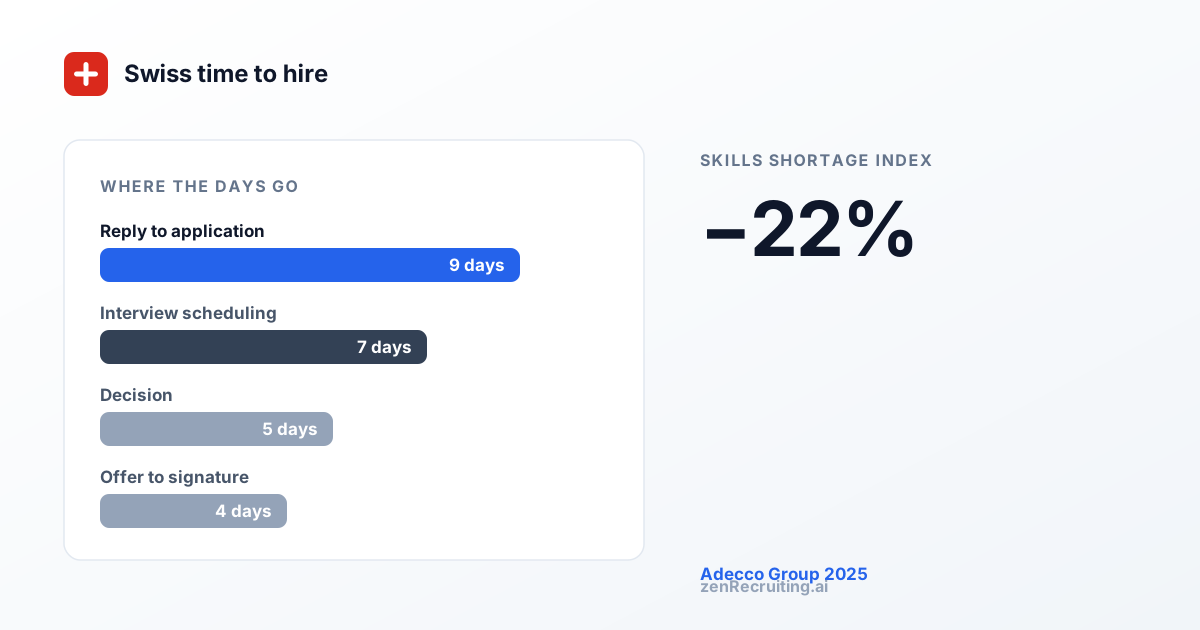
You post a job on a Monday. By Friday, three applications land in your inbox. Sounds fast, right? Then you interview. Then you wait for references. Then the offer sits unsigned for two weeks. Suddenly it's September and you still don't have your person.
This isn't unique to your company. Swiss SMEs without dedicated HR teams typically spend 60 to 90 days filling a single role—sometimes longer for specialized positions. The official job vacancy rate sits at 1.7% (BFS, Q1 2026), which sounds tight, but the real squeeze isn't availability; it's process.
Short version
- What's the average time-to-hire for Swiss SMEs?
- Most SMEs without HR fill a role in 60–90 days. This includes job posting, screening, interviews, background checks, and offer negotiation.
- Which hiring step takes the longest?
- Internal review and decision-making between interviews. Many teams delay feedback or take weeks between interview rounds.
- Where can I save the most time with least cost?
- Standardize your interview process and set hard deadlines for internal decisions. No software needed—just discipline.
- Is the Swiss labour market really that tight?
- It's softening. The Adecco Skills Shortage Index fell 22% year-on-year, and registered job seekers rose 17%. Less scarcity, but still slow hiring.
Where do the days actually go?
Let's break down a typical 75-day hiring cycle for an SME.
Days 1–7: Job posting and distribution. You write the ad, upload it to your site, maybe post to LinkedIn and a job board. Most SMEs do this in parallel with existing work, so it stretches.
Days 8–21: Applications and screening. You'll receive 5–20 applications depending on role and market. Screening resumes takes time, especially if you do it yourself between client calls or production demands.
Days 22–35: First interview round. Scheduling is the killer here. You need the hiring manager, sometimes a colleague, and the candidate free at the same time. Two weeks to coordinate isn't unusual.
Days 36–50: Second interview or internal deliberation. This is where many SMEs lose days. A manager forgets to give feedback. Another wants to see one more candidate 'just in case.' The process stalls.
Days 51–60: Reference checks and background verification. If you do this yourself, it's slow. If you use a service, it's faster but costs money.
Days 61–75: Offer, negotiation, and acceptance. The candidate asks for time to think. You adjust the salary. They accept. They give notice to their old employer (typically two weeks in Switzerland). You now have a start date—but you're at day 75 before they walk through your door.
Why is the Swiss market softening?
Recent data shows the labour squeeze easing, but not evenly.
The Adecco Group's Swiss Skills Shortage Index dropped 22% year-on-year—the second consecutive fall. Open positions fell 8%, while registered job seekers rose 17%. Unemployment climbed from 2.3% to 2.8%. Translation: it's a candidate's market less often and an employer's market slightly more often.
But here's the catch: it's uneven. Only 4 of 32 occupational groups show clear imbalance, with health professions leading the shortage. If you're hiring a nurse or care worker, the 90-day wait is real. If you're hiring an accountant or administrative role, you might have more leverage.
Geography also matters. German-speaking Switzerland fell 23%, Latin Switzerland 17%, Zurich 29%. If you're in Zurich, you're seeing the biggest relief. In smaller cities or rural areas, tightness persists.
The takeaway: don't assume scarcity anymore. Your candidate pool is larger than it was two years ago. The bottleneck is internal process, not external supply.
Adecco Group Swiss Skills Shortage Index 2025
The cheapest single fix: kill internal delays
You don't need to hire a recruiting agency or buy fancy software. You need discipline.
If you interview a candidate on day 25, the decision shouldn't land on day 35. Set a rule: feedback within 48 hours. If someone is travelling or in back-to-back meetings, another team member gives preliminary feedback. No exceptions.
This alone can cut 10–15 days from your cycle. That's a 15–20% time saving with zero cost beyond a calendar reminder.
Second: commit to interview slots upfront. Before posting the job, block two days next week for first interviews. Block one day two weeks later for second interviews. Publish these timelines to candidates. You'll lose some candidates who can't make those slots, but you'll move faster overall and attract people who are actively looking.
Third: automate reference checking. Call the references yourself if you need to—it takes 30 minutes per candidate. Or use a simple form (Google Forms works) and call only finalists. Most SMEs don't do this at all, which is why this step stretches.
Should you invest in recruitment tools?
Not before you fix your internal process.
If your hiring manager still forgets to review resumes or delays feedback by a week, a recruitment platform won't help. Tools amplify discipline; they don't create it. Fix the human process first.
That said, once you're reliably moving candidates through in 4–5 weeks, automation makes sense. An ATS can screen for keywords, a scheduling tool can handle calendar conflicts, an applicant tracking system can log decisions and timelines. These buy you 5–10 additional days per hire and cost €50–200 per month depending on features.
For SMEs, the sweet spot is a lightweight tool: a job board aggregator (posts to multiple sites at once), a simple ATS, and a shared hiring checklist in Notion or Google Sheets. Start there. Scale the tool only when you're hiring frequently enough to justify it.
One more thing: don't hire a full recruiting agency just to fill one role. You'll pay 15–25% of salary and lose control of the process. Use an agency only if you're hiring multiple roles at once and genuinely don't have internal bandwidth.
Make hiring faster without heavy investment
These tools address the specific bottlenecks SMEs face—without forcing you to overhaul your entire process.
- zenRecruiting.aiour tool
Smart candidate screening and scheduling. Cuts admin time in half, keeps decision-making in your hands.
Free, collaborative application tracking. Not fancy, but sufficient for SMEs up to 10 concurrent roles.
Eliminates scheduling back-and-forth. Saves 3–5 days per hire just on calendar coordination.
Reach passive candidates and advertise to specific roles. Often cheaper than traditional job boards.
The Swiss labour market is shifting. Candidate supply is improving, which means your hiring speed matters more than ever. If you take 90 days to fill a role, someone else will take 50. The difference isn't luck or connections—it's process. Start by mapping your current timeline, identify where decisions stall, and enforce deadlines. Then, if you want, add tools. But first, master the basics.
Sources
- BFS Employment Barometer Q1 2026 — Swiss Federal Statistical Office (BFS) — official job vacancy rate and employment data
- Adecco Group Swiss Skills Shortage Index 2025 — Labour market tightness index, regional breakdown, occupational imbalances